

+971 55 2022455





10 Exhibition Stand Design Trends That Will Dominate Trade Shows in 2026
Share
Posted On: August 3, 2026
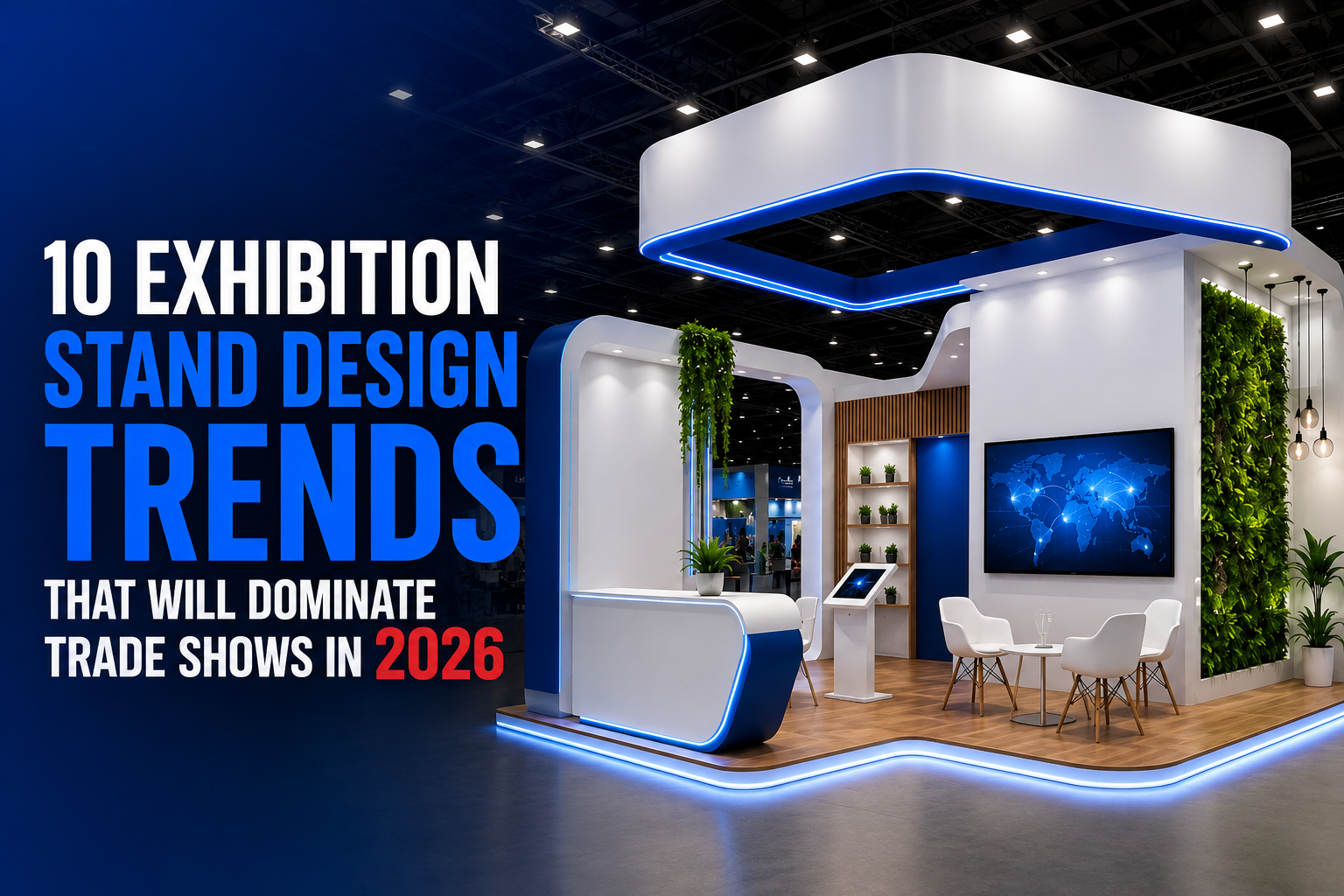
Exhibition stands are changing from static branded structures into interactive, measurable, and highly adaptable visitor experiences.
In 2026, an attractive booth will no longer be enough. Exhibitors will be expected to create spaces that help visitors understand the brand quickly, experience products directly, hold meaningful conversations, and continue engaging after the event.
Technology, artificial intelligence, sustainability, data, and human connection are becoming central to exhibition planning. UFI, the Global Association of the Exhibition Industry, has also identified experiences and engagement, technology and data, sustainability, and stronger human connections among the major forces shaping exhibitions in 2026.
For companies exhibiting in Dubai, Abu Dhabi, or international markets, understanding the latest exhibition stand design trends for 2026 can help them invest in concepts that remain relevant, practical, and capable of generating measurable business results.
This guide explores the ten trends expected to influence exhibition booths, trade show displays, and brand experiences throughout 2026.
Quick Overview of the Top Exhibition Stand Design Trends for 2026
| Trend | Main Purpose | Best Suited For |
|---|---|---|
| Sustainable and circular design | Reduce waste and improve reuse | Frequent and sustainability-focused exhibitors |
| Modular and adaptable stands | Reconfigure booths for multiple events | Brands attending different stand sizes |
| AI-powered experiences | Personalize visitor interactions | Technology and service brands |
| AR and VR integration | Demonstrate complex products | Healthcare, manufacturing, real estate and technology |
| Large digital displays | Communicate visually from a distance | Product launches and crowded exhibitions |
| Smart lead capture | Improve lead quality and follow-up | B2B exhibitors |
| Human-centred layouts | Encourage meaningful conversations | Professional services and high-value sales |
| Biophilic design | Create calmer and more welcoming spaces | Wellness, hospitality and premium brands |
| Zoned visitor journeys | Organize different booth activities | Medium and large exhibition stands |
| Phygital experiences | Extend engagement beyond the event | Brands with global or hybrid audiences |
1. Sustainable and Circular Exhibition Stand Design
Sustainability is moving from an optional branding statement to a practical requirement for exhibition planning.
In 2026, exhibitors will increasingly look for materials and construction methods that reduce waste without making the stand appear basic or unfinished.
Sustainable exhibition stand design can include:
- Reusable structural systems
- Recycled or responsibly sourced materials
- Low-energy LED lighting
- Fabric graphics that can be replaced without rebuilding the stand
- Rental furniture and display equipment
- Digital brochures instead of excessive printed material
- Components that can be stored and reused
- Local fabrication to reduce unnecessary transportation
The Events Industry Council’s Sustainable Event Standards assess events and suppliers across several areas of environmental and social responsibility. This reflects a wider industry shift toward measurable sustainability rather than unsupported environmental claims.
A sustainable stand should not simply use a few green materials. Its full lifecycle should be considered, including design, manufacturing, transportation, installation, dismantling, storage, and reuse.
For brands that attend several events each year, reusable systems can also reduce long-term costs and simplify future planning.
2. Modular and Adaptable Exhibition Stands
Modular exhibition stands will remain one of the most practical trade show booth trends in 2026.
A modular stand is built from reusable components that can be rearranged for different stand sizes, layouts, venues, and campaigns. This gives exhibitors more flexibility than a completely fixed structure.
For example, the same design system may be adapted from a compact 6-by-3-metre stand into a larger open-corner booth for another exhibition.
Modular designs are particularly useful for brands that:
- Participate in multiple trade shows
- Exhibit in different countries
- Frequently change product messaging
- Need to control production costs
- Want to reuse structural components
- Require faster installation and dismantling
However, modular does not have to mean generic. Custom graphics, lighting, product displays, furniture, digital screens, and branded finishes can make a modular booth feel distinctive.
Businesses deciding between both formats can review this detailed comparison of custom vs. modular exhibition stands.
3. AI-Powered and Personalized Visitor Experiences
Artificial intelligence will increasingly influence how exhibitors communicate with visitors.
In 2026, AI may be used inside exhibition stands to provide relevant recommendations, answer common questions, qualify prospects, and personalize digital content.
Practical applications may include:
- AI-powered product recommendation tools
- Interactive chatbots on touchscreens
- Multilingual digital assistants
- Personalized content based on visitor interests
- Automated appointment scheduling
- AI-supported lead scoring
- Real-time visitor sentiment analysis
- Post-event follow-up recommendations
For example, a visitor at a technology exhibition could select their industry and business challenge on a touchscreen. The system could then recommend the most relevant service, case study, demonstration, or team member.
AI should support human interaction rather than replace it. Visitors attending physical exhibitions still value genuine conversations, expert explanations, and personal trust.
The most effective AI exhibition experiences will remove friction and help booth staff focus on higher-value discussions.
4. Immersive AR and VR Product Demonstrations
Augmented reality and virtual reality will continue to transform how products are demonstrated at trade shows.
These technologies are particularly valuable when the actual product is:
- Too large to transport
- Difficult to demonstrate safely
- Still under development
- Located in another country
- Highly technical
- Available in multiple configurations
A property developer, for example, can use virtual reality to let visitors walk through a planned building. A manufacturer can use augmented reality to show the internal components of industrial machinery. A healthcare company can demonstrate a medical environment without transporting complex equipment.
Immersive technology can also help visitors understand information more quickly than long verbal explanations or printed brochures.
Common applications include:
- Virtual product tours
- Interactive 3D models
- AR-enabled brochures
- Virtual factory walkthroughs
- Product configuration tools
- Simulated training experiences
- Gamified brand interactions
Technology should have a defined purpose. Adding headsets or interactive screens simply because they look modern can create queues, technical problems, and confusion.
Read more about the power of AR and VR in modern exhibition stand designs.
5. LED Walls and Dynamic Digital Storytelling
Large digital displays will remain a major visual trend in exhibition stand design during 2026.
Static banners can communicate one message. Digital screens can display multiple products, demonstrations, customer stories, animations, event schedules, and live social content within the same space.
Popular options include:
- Seamless LED video walls
- Vertical digital displays
- Transparent LED screens
- Curved display systems
- Interactive touchscreens
- Digital product catalogues
- Live demonstration screens
- Motion-triggered content
The main advantage of digital storytelling is flexibility. Content can be updated before or during an exhibition without replacing printed graphics.
However, more screen space does not automatically create a better stand. Digital content should be readable within a few seconds and should support the booth’s main message.
Long corporate videos with small text are rarely suitable for busy exhibition halls. Short animations, strong headlines, product demonstrations, and clear visual sequences are generally more effective.
Exhibitors requiring screens, audiovisual equipment, or supporting furniture can explore LED, TV, and exhibition furniture rental services.
6. Data-Driven Exhibition Stands and Smart Lead Capture
Exhibition success will increasingly be evaluated through measurable visitor behaviour rather than footfall alone.
Smart exhibition stands can use digital tools to understand how visitors interact with different areas, products, and content.
Useful data may include:
- Number of visitors entering the stand
- Average visitor dwell time
- Most-viewed products
- Demonstrations completed
- QR codes scanned
- Meetings booked
- Leads captured
- Visitor interests
- Qualified sales opportunities
- Post-event conversions
Digital lead forms, badge scanners, CRM integrations, appointment-booking systems, and QR codes can make follow-up more efficient.
However, exhibitors should avoid collecting information without a clear purpose. Every question on a lead form should help qualify, segment, or follow up with the prospect.
A simple process may involve:
- Recording the visitor’s contact details.
- Selecting their industry or area of interest.
- Adding brief conversation notes.
- Assigning a lead category.
- Sending the information to the appropriate sales representative.
- Beginning personalized follow-up within 24 to 72 hours.
Data privacy and consent requirements should also be considered when collecting or analyzing visitor information.
7. Human-Centred Spaces Designed for Real Conversations
Despite rapid growth in exhibition technology, human connection will remain one of the most important design priorities in 2026.
A stand may look impressive but still perform poorly if visitors cannot enter comfortably, hear conversations, understand where to go, or find a suitable place to meet.
Human-centred exhibition stand design considers:
- Open and welcoming entrances
- Clear visitor pathways
- Accessible layouts
- Comfortable meeting areas
- Appropriate seating
- Acoustic control
- Storage for staff belongings
- Good lighting
- Charging points
- Spaces for private discussions
- Easy access to demonstrations
Accessibility should be considered at the design stage. Routes, counters, digital displays, seating areas, and demonstration zones should be usable by visitors with different mobility and accessibility needs.
Professional service firms and companies selling high-value products may benefit more from comfortable consultation areas than from filling the entire stand with displays.
The goal is to design around the conversation or action the visitor should complete.
For additional practical recommendations, review these exhibition stand design tips to increase visitor engagement.
8. Biophilic Design and Wellness-Focused Environments
Biophilic design uses natural materials, plants, organic forms, textures, and nature-inspired visual elements to create a more comfortable environment.
Exhibition halls can feel busy, noisy, artificial, and visually overwhelming. A stand that feels calmer and more welcoming may encourage visitors to pause and spend additional time inside.
Biophilic exhibition design may include:
- Living plants or green walls
- Natural wood finishes
- Stone-inspired surfaces
- Curved and organic shapes
- Earth-toned materials
- Soft, layered lighting
- Natural textures
- Open and breathable layouts
This approach is especially suitable for brands in wellness, healthcare, hospitality, food, sustainability, architecture, real estate, and premium consumer products.
Plants and natural materials should still be selected according to venue regulations, maintenance needs, fire-safety requirements, transportation, and installation conditions.
The objective is not to turn the booth into a garden. It is to use natural elements strategically to improve comfort and reinforce the brand story.
9. Zoned Layouts That Guide the Visitor Journey
Modern exhibition stands are increasingly designed as structured visitor journeys rather than single open rooms.
Each area of the stand can support a different stage of engagement.
A medium or large booth may contain:
- An attraction zone visible from the aisle
- A welcome and qualification area
- A product display zone
- A demonstration area
- An interactive technology station
- A consultation space
- A private meeting room
- A hospitality counter
- A lead-capture point
- Hidden storage
This zoning helps visitors understand where to go and prevents different activities from disrupting each other.
A live demonstration, for example, should not block the main entrance. Private sales discussions should not take place beside loud audiovisual displays. Lead registration should be positioned where it feels like a natural next step rather than a barrier to entry.
Stand dimensions, open sides, products, staff numbers, and expected visitor traffic should all influence the layout.
A successful stand begins with proper planning. Follow this step-by-step exhibition stand planning guide from concept to build before finalizing the design.
10. Phygital and Extended Exhibition Experiences
The term “phygital” describes an experience that connects physical and digital interactions.
In 2026, the visitor journey will increasingly begin before the exhibition and continue after it ends.
An exhibitor might:
- Launch an event landing page before the show
- Allow prospects to book booth meetings online
- Share previews through email and social media
- Use QR codes to unlock digital content
- Stream selected booth demonstrations
- Provide downloadable product resources
- Send personalized follow-up content
- Invite visitors to online product sessions
- Retarget engaged visitors through digital campaigns
This approach helps businesses generate value from an exhibition beyond the people physically standing at the booth.
A demonstration recorded during the event could later become a sales video, social media clip, product tutorial, email resource, or website asset.
Exhibitors should therefore design not only for the exhibition hall but also for cameras, mobile screens, social sharing, and post-event content.
How to Select the Right Exhibition Stand Trends for Your Brand
Not every trend should be included in every stand.
The most suitable features depend on:
- Exhibition objectives
- Target audience
- Stand size
- Venue restrictions
- Products being presented
- Brand positioning
- Available budget
- Event frequency
- Staff capability
- Reuse plans
- Data and technology requirements
Before selecting a concept, ask:
- What should visitors understand within the first five seconds?
- Which action should they take inside the stand?
- What information can be shown digitally?
- Which parts of the stand can be reused?
- How will leads be captured and followed up?
- Does the design support visitor and staff comfort?
- Can the technology be tested and supported on-site?
- How will the stand’s performance be measured?
Businesses can also examine completed projects in the Global Brandings exhibition stand portfolio for practical design inspiration.
Common Mistakes to Avoid When Following Exhibition Design Trends
Adding Technology Without a Clear Purpose
A touchscreen, VR headset, or LED wall should support communication, qualification, or demonstration. Technology that does not contribute to the visitor journey may waste space and budget.
Overloading the Stand With Messages
Visitors do not have time to read paragraphs of text while walking through a busy exhibition. Use one strong primary message supported by short secondary points.
Ignoring Visitor Flow
Furniture, displays, counters, and demonstrations should not obstruct the entrance or create unnecessary congestion.
Choosing Appearance Over Functionality
A visually impressive design still needs accessible storage, staff areas, meeting space, electrical access, and practical product-display solutions.
Copying Competitors
Trends should be adapted to the company’s own identity. A stand becomes memorable when design elements are connected to a clear and distinctive brand story.
Learn how exhibition stand design helps build a strong brand identity.
Beginning the Project Too Late
Custom fabrication, technical coordination, approvals, content production, logistics, and installation require time. Exhibitors should begin planning well before the event.
Working with an experienced partner can simplify the process. This guide explains how to choose the right exhibition stand builder.
Frequently Asked Questions
Q. What are the biggest exhibition stand design trends for 2026?
The main exhibition stand design trends for 2026 include sustainable materials, reusable modular structures, AI-powered experiences, AR and VR demonstrations, LED walls, smart lead capture, human-centred layouts, biophilic design, defined visitor zones, and phygital engagement.
Q. Are modular exhibition stands still popular in 2026?
Yes. Modular exhibition stands remain popular because they can be reused and reconfigured for different events, booth sizes, and marketing campaigns. Custom graphics, lighting, technology, and branded finishes can be added to create a more distinctive appearance.
Q. How will AI be used in exhibition stands?
AI can be used for multilingual visitor support, product recommendations, appointment scheduling, lead qualification, personalized digital content, visitor analytics, and post-event follow-up. It should support rather than replace human conversations.
Q. Are AR and VR suitable for every exhibition stand?
No. AR and VR are most effective when they help visitors understand a product, environment, or process that would otherwise be difficult to demonstrate. The experience should be quick, reliable, relevant, and simple for visitors to use.
Q. How can an exhibition stand be made more sustainable?
An exhibition stand can be made more sustainable by using reusable structures, recycled or responsibly sourced materials, rental furniture, energy-efficient lighting, replaceable fabric graphics, digital brochures, and locally produced components.
Q. What makes an exhibition stand interactive?
An interactive exhibition stand encourages visitors to actively participate through touchscreens, product demonstrations, games, AR or VR experiences, surveys, digital configurators, live presentations, or hands-on product trials.
Q. How can exhibition stand ROI be measured?
Exhibition stand ROI can be evaluated using qualified leads, booked meetings, demonstrations, dwell time, engagement, sales opportunities, follow-up conversions, revenue generated, and cost per qualified lead. The measurement method should be established before the exhibition.
Q. Should a company choose a custom or modular stand?
A custom stand is suitable for brands seeking maximum creative freedom and a distinctive one-event presence. A modular stand is more suitable for businesses that exhibit regularly and need a reusable, adaptable, and cost-controlled solution.
Conclusion
The leading exhibition stand design trends for 2026 reflect a clear shift from decorative booths toward purposeful brand experiences.
Sustainability, modularity, artificial intelligence, immersive technology, digital displays, and visitor data will influence how stands are planned. At the same time, comfortable spaces, clear communication, accessibility, and genuine human interaction will remain essential.
The best exhibition stand will not be the one that uses the highest number of trends. It will be the one that selects the right ideas for its audience, objectives, products, and exhibition environment.
Global Brandings provides complete exhibition stand design and event services in the UAE, including concept development, fabrication, branding, digital displays, installation, and on-site execution.
Planning an upcoming trade show in Dubai, Abu Dhabi, or another international market? Contact Global Brandings to discuss an exhibition stand designed around your brand, audience, and business objectives.
Key Takeaways
- Sustainability and reusable components will play a larger role in exhibition planning.
- Modular systems provide greater flexibility for brands attending multiple events.
- AI will support personalization, lead qualification, and visitor engagement.
- AR and VR can make complex products easier to understand.
- LED displays allow exhibitors to update and expand visual storytelling.
- Data-driven lead capture can improve event follow-up and ROI measurement.
- Human-centred layouts remain essential despite increased use of technology.
- Biophilic design can create calmer and more welcoming booth environments.
- Zoned layouts help visitors move naturally through different activities.
- Phygital experiences extend exhibition engagement before and after the event.
Tell us about your Requirement
Exhibition Stand Builder in Riyadh, Saudi Arabia: The Complete 2026 Guide
22/08/2026
Riyadh has become the beating heart of trade shows, B2B exhibitions, and corporate events in the Middle East. From the Riyadh International Convention & Exhibition Center (RICEC) to Malham International Exhibition & Convention Center, brands from every industry now compete for attention on the show floor. Choosing the right exhibition stand builder in Riyadh is no longer a “nice to
Read More
