

+971 55 2022455





A Step-by-Step Guide to Planning Your Exhibition Stand From Concept to Build
Share
Posted On: July 9, 2026
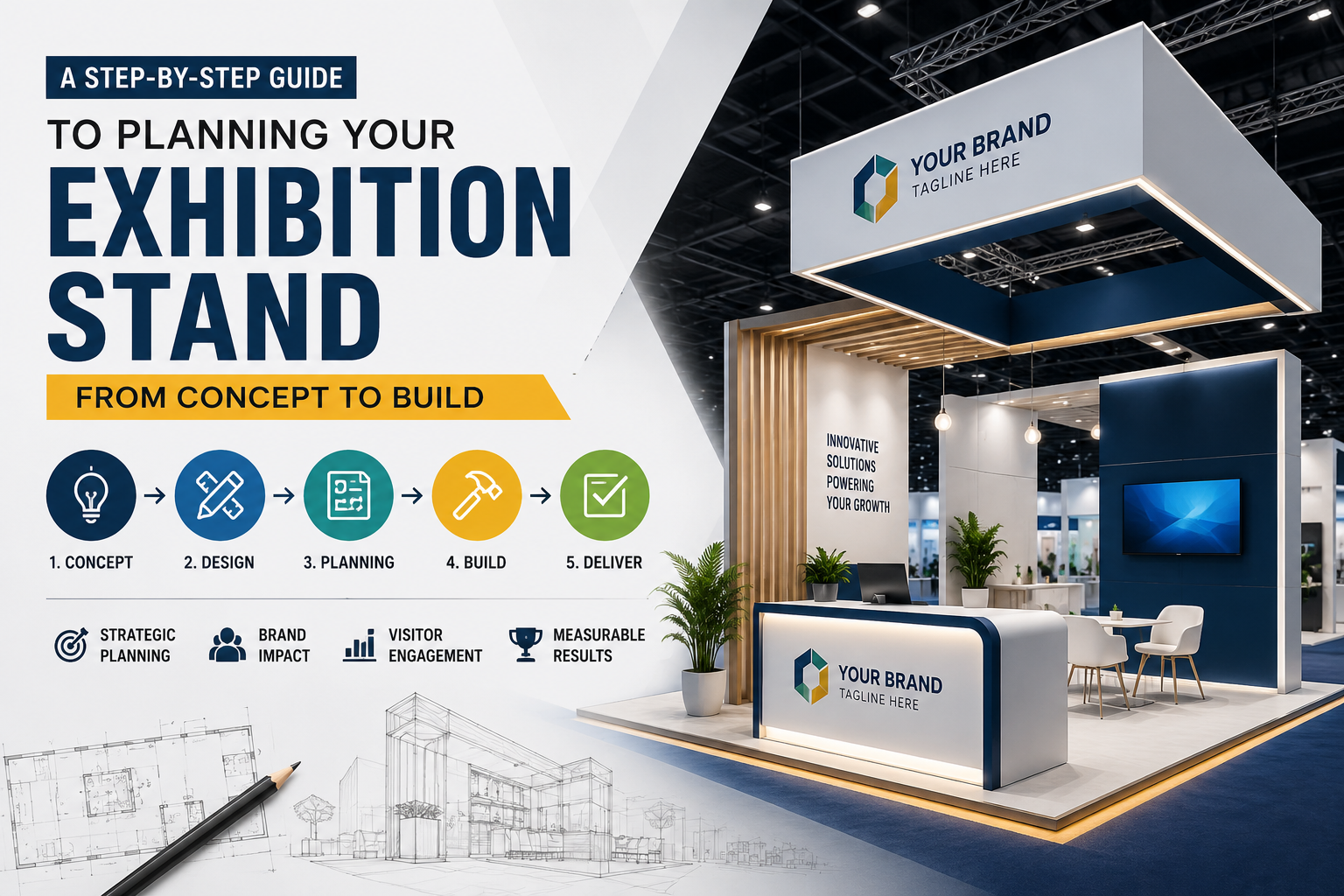
An exhibition stand can be one of the most important visual investments a company makes at a trade show. However, an attractive design alone does not guarantee results. Successful stands are supported by clear objectives, realistic budgets, practical layouts, reliable fabrication, trained staff, and a defined process for measuring performance.
This exhibition stand planning guide explains how to take a stand from the initial concept through design, fabrication, installation, and post-event evaluation. It is designed for marketing managers, business owners, event teams, procurement professionals, and exhibitors who need a reliable framework for managing the complete process.
Whether you are planning your first exhibition booth or improving an existing event strategy, the steps below will help you reduce last-minute problems, communicate more clearly with your contractor, and create a stand that supports measurable business goals.
For professional support with design, fabrication, logistics, and installation, explore our exhibition stand design and build services.
Exhibition Stand Planning at a Glance
Exhibition stand planning is the process of defining your event objectives, budget, stand type, floor layout, branding, technology, fabrication requirements, logistics, staffing, and performance metrics before the exhibition begins.
A complete planning process normally includes:
- Setting measurable objectives
- Researching the venue and audience
- Defining the available budget
- Selecting the appropriate stand type
- Planning the layout and visitor journey
- Finalizing branding and messaging
- Choosing technology and interactive elements
- Managing fabrication and logistics
- Training the exhibition team
- Measuring performance after the event
Starting early gives your team more time to obtain venue approvals, review 3D designs, prepare artwork, coordinate production, and address unexpected changes.
What Is Exhibition Stand Planning?
Exhibition stand planning is the strategic and operational process used to design, build, install, manage, and evaluate a trade show stand.
It connects the company’s commercial goals with the physical exhibition environment. Instead of treating the stand as a temporary structure, effective planning considers how the space will attract visitors, communicate the brand message, support conversations, demonstrate products, capture leads, and deliver measurable results.
Important Exhibition Stand Terms
Exhibition stand:
A branded structure used to represent a company at a trade show, conference, expo, or industry event.
Exhibition stand design:
The creative and technical process of planning the stand’s appearance, layout, materials, visitor flow, and functional areas.
Exhibition stand builder:
A company responsible for turning an approved design into a physical structure and managing fabrication, installation, and dismantling.
Custom exhibition stand:
A stand designed specifically around a company’s brand, event objectives, products, and available floor space.
Modular exhibition stand:
A reusable system built from pre-engineered components that can be adjusted for different stand sizes and events.
Exhibition stand fabrication:
The manufacturing process in which design drawings are converted into panels, counters, flooring, frames, displays, and other physical components.
Exhibition booth planning:
The wider project-management process covering the stand design, budget, venue requirements, technology, logistics, staffing, and lead-capture strategy.
Clearly defining these terms helps prevent scope confusion between the exhibitor, designer, builder, venue, and other suppliers.
What Should an Exhibition Stand Brief Include?
A detailed stand brief helps the designer and builder understand exactly what the business needs.
Include the following information:
- Exhibition name, location, and event dates
- Stand number and allocated floor-space dimensions
- Main business and marketing objectives
- Target audience and visitor profile
- Products or services being promoted
- Required demonstration or product-display areas
- Reception, meeting, hospitality, and storage needs
- Brand guidelines, approved colors, and logos
- Primary marketing message
- Screens, lighting, power, internet, and AV requirements
- Accessibility requirements
- Budget range
- Installation and dismantling schedule
- Lead-capture method
- Venue technical and safety regulations
The clearer the initial brief, the easier it becomes to evaluate designs, compare quotations, and control project changes.
Exhibition Stand Planning Timeline
The exact timeline depends on the stand size, complexity, location, venue requirements, and selected construction method. The following framework can be used as a general planning guide.
| Time Before the Event | Main Activities |
|---|---|
| 12 or more weeks | Define objectives, budget, audience, and initial requirements |
| 8–12 weeks | Select the stand builder and approve the creative direction |
| 6–8 weeks | Finalize the floor plan, 3D design, materials, and branding |
| 4–6 weeks | Begin fabrication, graphics production, and technology preparation |
| 2–4 weeks | Confirm venue approvals, logistics, staffing, and lead-capture systems |
| Final week | Coordinate installation, complete quality checks, and brief the team |
| After the event | Follow up with leads and evaluate performance |
Large custom stands, international projects, or stands requiring complex technology may need additional planning time.
Exhibition Stand Planning Guide: 10 Steps From Concept to Build
Step 1: Set Clear and Measurable Objectives
Every effective exhibition stand should begin with a clear purpose.
Common objectives include:
- Generating qualified leads
- Launching a new product or service
- Increasing brand awareness
- Meeting distributors, investors, or business partners
- Demonstrating products
- Booking sales appointments
- Supporting direct or post-event sales
Avoid using broad goals such as “increase visibility” without defining how visibility will be measured.
Instead, establish measurable targets, such as:
- Number of qualified leads
- Number of product demonstrations
- Meetings booked
- Sales opportunities created
- Visitor interactions
- Cost per lead
- Follow-up conversion rate
These objectives will influence the stand size, layout, staffing requirements, technology, and budget.
Step 2: Research the Venue, Audience, and Competitors
Every exhibition has a different audience, venue layout, build schedule, and technical manual.
Before approving the design, review:
- Stand location
- Number of open sides
- Nearby entrances and visitor routes
- Ceiling and height restrictions
- Rigging permissions
- Power, water, and internet access
- Fire-safety requirements
- Loading and unloading procedures
- Build-up and dismantling times
- Expected visitor profile
- Nearby exhibitors and competitors
Corner and island stands can provide visibility from multiple directions, while inline stands require stronger front-facing branding and more careful use of the available entrance.
The design should respond to the actual location rather than being created without reference to the venue floor plan.
Step 3: Create a Realistic Exhibition Stand Budget
A complete exhibition budget includes more than the physical structure.
Common budget categories include:
| Budget Category | What It May Include |
|---|---|
| Design and planning | Creative concept, floor plan, technical drawings, and 3D visualization |
| Construction | Structure, flooring, walls, counters, furniture, and finishing |
| Branding | Printed graphics, signage, logos, displays, and branded elements |
| Technology | Screens, lighting, internet, audio, and interactive equipment |
| Venue services | Electricity, rigging, permits, waste management, and access charges |
| Logistics | Transport, storage, installation, and dismantling |
| Staffing | Hosts, promoters, travel, accommodation, and staff training |
| Contingency | Unexpected production, venue, or logistics expenses |
Rather than focusing only on the initial quotation, ask for a clear breakdown of what is included and excluded.
Confirm whether the quotation covers:
- Installation
- Dismantling
- Transport
- Electrical work
- Venue approvals
- Furniture
- AV equipment
- Storage
- On-site project management
Businesses working with limited space or budgets can also review these exhibition stand design ideas for small businesses.
Step 4: Choose the Right Exhibition Stand Type
The best stand type depends on the available budget, event schedule, brand requirements, storage capacity, and expected frequency of use.
| Stand Type | Suitable For | General Planning Requirement | Reusability |
|---|---|---|---|
| Custom-built | Flagship events and distinctive brand experiences | Longer design and production process | Components may be reusable depending on design |
| Modular | Companies attending multiple exhibitions | Faster adaptation across different spaces | High |
| Portable or pop-up | Smaller events and simple lead-generation stands | Shorter setup and preparation | Very high |
| Hybrid | Brands balancing customization and reuse | Combines modular structure with custom elements | Moderate to high |
Custom stands provide greater creative flexibility. Modular stands are easier to reconfigure, transport, and reuse. Hybrid solutions combine reusable frameworks with custom graphics, finishes, or feature areas.
Review our detailed comparison of custom vs. modular exhibition stands before choosing a system.
Step 5: Plan the Stand Concept and Floor Layout
The stand layout should support the visitor journey and the objectives defined at the beginning of the project.
Important layout principles include:
Maintain Open Sightlines
Visitors should be able to understand the stand’s main purpose from the aisle. Avoid placing large structures where they block branding, products, or entrances.
Create a Clear Focal Point
Use a primary feature such as:
- A product display
- Demonstration zone
- Digital screen
- Branded backdrop
- Sculptural feature
- Reception counter
The focal point should direct attention toward the stand’s most important message.
Define the Visitor Journey
Plan how visitors will:
- Notice the stand
- Enter the space
- Understand the offer
- Speak with the team
- View a demonstration
- Share their contact details
- Move to a meeting area or exit
Include Functional Zones
Depending on the objective, the stand may require:
- Reception area
- Product display
- Demonstration space
- Open conversation zone
- Private meeting room
- Hospitality counter
- Lead-capture station
- Concealed storage
Use 3D Visualization
A 3D render helps the team review dimensions, branding, sightlines, materials, furniture, lighting, and visitor flow before fabrication begins.
Also review these important factors to consider when choosing an exhibition stand.
Step 6: Finalize Branding and Messaging
Trade show visitors are exposed to many competing messages. Your stand should communicate its value quickly and clearly.
Focus on:
- One primary value proposition
- A short and benefit-led headline
- Consistent brand colors and typography
- Large, readable graphics
- Clear product or service categories
- Visible logo placement
- A simple call to action
Avoid filling every wall with paragraphs of text. Visitors should be able to understand who you are, what you offer, and why they should stop without having to read a brochure.
Messaging should be visible from the aisle and should remain consistent across the stand, brochures, screens, staff conversations, and follow-up communication.
Learn more about how exhibition stand design supports a strong brand identity.
Step 7: Select Technology and Interactive Features
Technology should support the exhibition objective rather than being added only for visual effect.
Useful options may include:
- Touchscreen product catalogs
- Interactive product selectors
- QR-code lead forms
- Badge-scanning systems
- Digital demonstration screens
- Video walls
- Appointment-booking tools
- AR or VR demonstrations
- Live product demonstrations
A well-positioned demonstration screen can help visitors understand a product in use, especially when the content is short, clear, and visible from the aisle.
Before adding technology, confirm:
- Internet requirements
- Power supply
- Screen visibility
- Audio restrictions
- Equipment security
- Staff training
- Backup options
For additional examples, explore the role of AR and VR in exhibition stand design.
Step 8: Manage Fabrication, Logistics, and Compliance
After the design is approved, the exhibition stand builder begins the technical and fabrication process.
This stage may include:
- Technical drawings
- Structural calculations
- Material procurement
- Joinery and component production
- Graphics printing
- Lighting preparation
- Electrical work
- AV equipment testing
- Quality inspections
- Packing and transport
The stand must also comply with the venue and organizer’s requirements.
Check:
- Height restrictions
- Fire-rated material requirements
- Electrical certifications
- Rigging regulations
- Contractor passes
- Loading-bay bookings
- Build-up access times
- Waste-removal rules
- Dismantling deadlines
For international events, allow additional time for transport documentation, customs procedures, local labor coordination, and venue access.
Planning an Exhibition Stand in Dubai and the UAE
Exhibitions in Dubai, Abu Dhabi, and other UAE locations may involve venue-specific technical manuals and contractor procedures.
Before production begins, confirm:
- Maximum stand height
- Rigging and suspended signage rules
- Fire and safety documentation
- Electrical connection procedures
- Contractor and vehicle access passes
- Loading-bay schedules
- Build-up and dismantling windows
- Venue-approved suppliers
- Waste disposal requirements
Requirements can vary by event and venue. Always review the latest exhibitor manual supplied by the organizer before approving the final design.
Step 9: Prepare and Brief Your Exhibition Team
A well-designed stand will not perform effectively without a prepared team.
Before the event:
- Walk staff through the stand layout
- Explain the primary objective
- Define the ideal customer profile
- Set lead-qualification criteria
- Assign responsibilities by zone
- Explain the lead-capture process
- Practice short conversation starters
- Confirm break schedules
- Prepare escalation procedures for technical issues
Instead of using aggressive scripts, train staff to ask relevant questions and identify what each visitor needs.
Everyone should know:
- Who should greet visitors
- Who handles demonstrations
- Who manages meetings
- Who records leads
- Who solves operational problems
Step 10: Install, Monitor, and Evaluate the Stand
An experienced project manager should supervise installation and complete a final quality check before the exhibition opens.
Check:
- Structural stability
- Graphics and spelling
- Lighting
- Screens and equipment
- Internet connection
- Furniture placement
- Storage access
- Cleaning
- Lead-capture tools
- Safety and accessibility
During the event, monitor:
- Visitor numbers
- Qualified leads
- Meetings booked
- Demonstrations completed
- Visitor questions
- Dwell time
- Staff feedback
- Layout bottlenecks
- Technology problems
After the event, compare the results with the objectives established in Step 1.
A useful post-event review should cover:
- What worked well
- Which areas attracted the most attention
- Which visitor questions appeared repeatedly
- Which leads should be prioritized
- What should be changed before the next exhibition
This feedback creates a repeatable process for improving future stands.
Benefits of a Well-Planned Exhibition Stand
Better Lead Quality
Clear messaging and structured visitor flow can help attract people who are more relevant to the company’s offer.
Stronger Brand Recognition
Consistent design, messaging, and visual identity make the brand easier to recognize during and after the exhibition.
More Effective Use of Budget
Early planning allows the team to compare options, reduce rushed decisions, and identify costs before production begins.
Fewer Last-Minute Problems
Reviewing venue rules, logistics, artwork, and technical requirements early reduces the likelihood of avoidable changes on-site.
Improved Staff Performance
A trained team can manage conversations, demonstrations, meetings, and lead capture more consistently.
Easier Performance Measurement
Defined objectives make it easier to evaluate leads, meetings, opportunities, and cost per result.
Common Exhibition Stand Planning Challenges
Tight Timelines
Late approvals can affect design quality, material availability, graphics production, venue submissions, and installation planning.
Changing Requirements
Stand size, product displays, messaging, or technology may change during the project. A clear approval process helps control revisions.
Venue Restrictions
Height limits, rigging requirements, electrical rules, and fire-safety procedures may influence the final design.
Budget Overruns
Costs can increase when important items such as venue services, transport, storage, installation, or technology are excluded from the initial estimate.
International Logistics
Cross-border projects require additional coordination for shipping, customs, local contractors, and venue access.
Sustainability Requirements
Many exhibitors are looking for reusable structures, recyclable materials, efficient lighting, and reduced production waste.
Exhibition Stand Planning Best Practices
- Start planning as early as possible.
- Define objectives before discussing design styles.
- Share a complete written brief with the builder.
- Review the venue manual before approving the concept.
- Ask for a detailed and transparent quotation.
- Use 3D renders to review the proposed layout.
- Keep the main marketing message simple.
- Design the stand around visitor behavior.
- Include practical storage and operational space.
- Test technology before the exhibition opens.
- Train staff on lead qualification and follow-up.
- Complete a post-event performance review.
Exhibition Stand Design Trends and Future Outlook
Exhibition stand design is becoming more flexible, measurable, and operationally efficient.
Important trends include:
Modular and Reusable Systems
Brands attending several exhibitions are increasingly considering structures that can be adapted to different floor spaces.
Sustainable Materials
Reusable components, lower-waste production methods, energy-efficient lighting, and recyclable graphics are becoming more important during planning.
Integrated Lead Capture
QR codes, appointment-booking systems, badge scanning, and CRM connections can make lead collection and follow-up more organized.
Interactive Product Demonstrations
Screens, digital product selectors, AR, VR, and live demonstrations can help explain products that are difficult to display physically.
Flexible Meeting Spaces
Open conversation areas combined with private meeting zones allow teams to manage both quick visitor interactions and detailed business discussions.
Data-Informed Stand Planning
Lead quality, visitor behavior, staff feedback, and event performance can be used to improve future stand layouts and messaging.
Frequently Asked Questions
What is exhibition stand planning?
Exhibition stand planning is the process of defining the stand’s objectives, budget, layout, branding, construction, logistics, staffing, and measurement strategy before the event. It ensures that the design supports practical business goals.
How far in advance should I plan an exhibition stand?
Planning should begin as early as possible. Custom stands usually need more time for design, approvals, fabrication, and logistics, while portable or modular systems may require shorter preparation periods. The venue schedule and project complexity should determine the final timeline.
What should an exhibition stand brief include?
A stand brief should include the event details, stand dimensions, objectives, target audience, required zones, products, branding, technology, budget, logistics, accessibility needs, and venue regulations.
How much does an exhibition stand cost?
The cost depends on the stand size, construction type, materials, location, technology, furniture, venue charges, transport, installation, and staffing. Ask for a detailed quotation showing what is included and excluded.
What is the difference between a custom and modular exhibition stand?
A custom stand is developed around a specific brand and project, providing greater design flexibility. A modular stand uses reusable components that can be adjusted for different events and stand sizes.
How do I choose an exhibition stand builder?
Review the builder’s portfolio, relevant industry experience, venue knowledge, project-management capability, quotation transparency, fabrication process, installation support, and ability to meet deadlines.
What technology should I include on the stand?
Choose technology that directly supports the objective. Product screens, digital catalogs, badge scanning, QR-code forms, appointment booking, or interactive demonstrations can be useful when they improve the visitor experience or lead-capture process.
How do I measure exhibition stand performance?
Measure performance using the objectives established before the event. Relevant metrics may include qualified leads, meetings booked, demonstrations completed, sales opportunities, follow-up conversions, and cost per lead.
Can an exhibition stand be reused?
Yes. Modular and hybrid stands are designed for reuse, while selected elements of a custom stand may also be stored, adapted, or reused depending on the original design and materials.
Conclusion
Planning an exhibition stand from concept to build requires more than choosing colors, graphics, and furniture. It is a structured project that connects business objectives with design, visitor flow, construction, venue compliance, logistics, staff preparation, and performance measurement.
Companies that begin with a clear brief, involve the stand builder early, and review every operational requirement are better positioned to avoid rushed decisions and create a more effective exhibition experience.
Browse our exhibition stand project portfolio to view completed work, or contact our exhibition team to discuss your next project.
Key Takeaways
- Define measurable objectives before starting the design.
- Prepare a complete exhibition stand brief.
- Review venue requirements at the beginning of the project.
- Select the stand type based on budget, reuse, and event frequency.
- Use the floor layout to support visitor flow and lead generation.
- Keep the main brand message clear and visible.
- Include technology only when it serves a practical purpose.
- Coordinate fabrication, logistics, and venue approvals early.
- Train staff before the exhibition begins.
- Measure performance and document improvements for the next event.
Tell us about your Requirement
Exhibition Stand Builder in Riyadh, Saudi Arabia: The Complete 2026 Guide
22/08/2026
Riyadh has become the beating heart of trade shows, B2B exhibitions, and corporate events in the Middle East. From the Riyadh International Convention & Exhibition Center (RICEC) to Malham International Exhibition & Convention Center, brands from every industry now compete for attention on the show floor. Choosing the right exhibition stand builder in Riyadh is no longer a “nice to
Read More
