

+971 55 2022455





How to Prepare Your Exhibition Stand for a Major Trade Show in Dubai
Share
Posted On: October 15, 2026
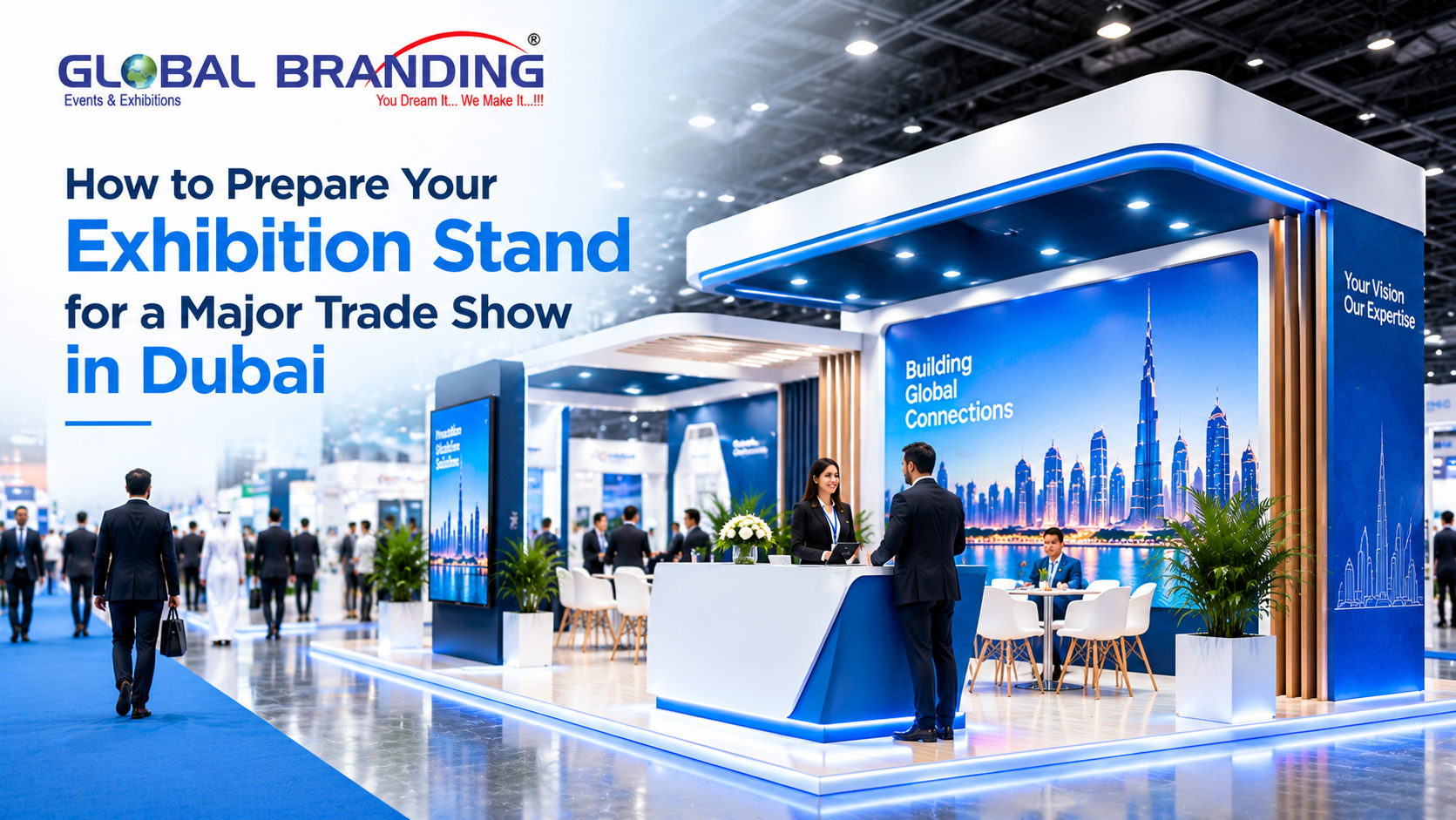
Preparing for a Major Trade Show in Dubai needs to consider many other aspects besides the design of the stand. There are many other things that companies need to do in addition to designing a nice stand, such as: stand building, venue approval, marketing materials, staff training, product presentations, and lead capture before the show opens to the public. Any of these things that are overlooked could raise costs and lower ROI.
Working with an experienced exhibition stand constructor can help transform the company’s vision into reality. However, there are also other factors that contribute to a successful exhibition in Dubai. Preparing the stand takes time, whether it is the first time for the business at an event or another round in the industry.
This article gives vital tips for preparing to participate in a trade show in Dubai, such as defining the show’s goals, staying within the budget, choosing a suitable stand, and measuring ROI after the event.
1. Set Your Exhibition Objectives before Designing a Stand
An exhibition stand is a powerful marketing tool, and companies should set their goals before finding the best exhibition stand builder in Dubai. The goals will assist you in deciding the size, design, graphics, technology, staffing and budget of your booth.
Organizations usually set targets for themselves like qualifying sales leads, launching a new product/service, contacting new distributors/partners, setting up meetings with existing customers, showing off their products to potential customers and gaining more recognition from other organizations. One objective and two secondary objectives are important for an organization for a trade show.
For instance, a B2B tech company may set up product showcases and sales meetings as the main objective and a manufacturing firm may highlight the need for equipment displays and technical talks.
Wherever possible, it is advisable to measure the targets to achieve at the event. This may include number of leads, product demonstrations and meetings arranged, and prospects contacted. Clear trade show goals will help the exhibition stand builder understand the requirements and measure the results achieved.
2. Set a Realistic Budget and Schedule for Preparation
One common mistake made when setting up an exhibition is the underestimation of preparation time. In addition, the stand budget is often determined solely by design and construction costs. Businesses should have a realistic idea of their overall costs in mind before choosing a particular stand contractor.
Overall, expenses concern the venue hiring, its design and graphics, furniture and technologies, special permits and services, transport, installation, crew’s travel and accommodation, marketing materials, and post-event support. While reviewing quotations from potential stand builders, one should be keen to check if additional costs concern the services requested or not. Indeed, a cheaper option may have significant extra charges for the installation, project management, and technical support.
When should one begin preparing for an exhibition? In general, the preparation time for stand construction is established several months in advance of the event, depending on its scale and complexity. A customised stand with imported materials and complicated installations will take more time than a modular structure. Here is a sample timeline for planning an exhibition:
- Three to six months before the event: Determine your primary goals, set a realistic budget, identify the required space, and review design options.
- 2 to 3 months before the event: Approve the concept, obtain quotations, create technical drawings, and submit documents for approval.
- 4-8 weeks preceding the event: Specify the graphics, equipment, product presentation, promotional materials, and staffing options;
- 1-2 weeks before the event: Coordinate logistics, access and appointments, and special technical requirements;
- During the construction of the stand: Review the design, test the equipment, and inspect the stand before the opening.
These particular guidelines are only an example, and there may well be other factors to consider when preparing for an exhibition. It is essential to bear in mind that each exhibition has its requirements, which must also be taken into account when planning the event.
3. Know What to Look for in an Exhibition Stand Builder in Dubai
Exhibition stand constructors are responsible for the exhibit’s characteristics, including construction, timeline, and technical specifications. The wrong choice of a contractor may result in project delays, additional costs, and other issues. When looking for an exhibition stand builder in Dubai, it is necessary to consider several factors:
- Portfolio: The company’s experience helps to understand the level of expertise; therefore, it is essential to study the past projects of the desired contractor. Ideally, the requested stand should have analogs in the firm’s portfolio.
- Project management: Ask the potential supplier about project leadership and cooperation details, including the responsibilities for design, fabrication, graphics, installation, and technical aspects.
- Technical capabilities: Inquire whether the contractor has the skills and equipment needed for your project and familiar with the technical requirements of the chosen venue.
- Quotation transparency: Clarify what materials and services are included in the offer and if there are any additional expenses.
- On-site support: Determine who will assist with technical issues during the event, including lighting, graphics, or equipment malfunctions.
- Practical questions: It is essential to ask the contractor not about the design but about how they would fulfill practical aspects of the fair.
Global Branding Events & Exhibitions has been helping organisations achieve their exhibition objectives since 2012. The company has delivered branded experiences to numerous exhibitors across the UAE and over 32 countries. With this extensive expertise, Global Branding can offer end-to-end exhibition support for businesses of all sizes. It also works as an exhibition stand builder in France and an exhibition stand company in Germany. You can contact the company to learn more about their experience and cooperation terms.
4. Think about How Visitors Will Experience Your Stand
An exhibition stand is a reflection of a brand and serves to communicate the company’s value to potential customers. The design and layout should facilitate the visitor’s journey, enabling them to explore offerings and engage in discussions.
First of all, exhibition stand designers should be able to answer three basic questions:
- What should I see from a distance?
- What should I know when approaching the stand?
- What should I do next?
These cues will enable potential customers to navigate the booth, so it is essential to plan them in advance. For instance, the company’s name and value proposition should be easy to spot from a distance, and the headline should be short and informative rather than using up all the space on a board. It is also important to leave room for product showcases, meetings, and storage, depending on the size of the stand. Heavy furniture and displays should not block access to the booth.
Another important design feature is the stand’s location. A business needs to know where to place its stand within an exhibition hall. For example, corner and island stands provide better visibility. In addition, businesses should consider using modular displays, vertical signs, and other space-saving tools.
5. Review Venue Requirements and Approvals for Your Stand
Exhibition organisers impose requirements on stands, a list of which needs to be followed by businesses to prevent problems. Approval guidelines are different at different venues, which means a business needs to consult the standards imposed by a particular exhibition. Organisers are entitled to restrict such factors as height, safety, electricity, rigging, and others.
For example, Dubai World Trade Centre asks exhibitors to contact its event organiser and review exhibitor documentation for service requirements. The venue offers a variety of services, including stand construction, rigging, electricity, and others. Businesses should contact the chosen exhibition venue to clarify requirements, including technical specifications, drawings, documents, and approvals.
Before building the stand, it is essential to understand the following:
- Approved stand dimensions;
- Deadlines for submitting drawings for approval;
- Additional requirements, including calculations if needed;
- Electricity, rigging, and other technical specifications;
- Registration and access requirements for the event;
- Safety regulations for product showcases and other displays;
- Build, inspection, and dismantle schedules;
- Other special instructions or restrictions.
Venue approval requirements can vary for different exhibitions, even at the same venue. While the same stand might be approved for one event, it may need amendments for another fair. It is advisable to obtain all the necessary documents from the selected stand builder and double-check requirements before installing the stand.
6. Develop Your Brand Materials, Product Showcases, and Digital Assets
While an exhibition stand can draw in crowds, it is necessary to offer valuable content so that visitors want to engage with the brand. Every detail in the display should provide the public with some useful information about the company. Product displays, for instance, should have relevant data, including specifications and other details. It is essential to review all the materials to ensure that the information is up-to-date and presented clearly. Before heading to the venue, it is a good idea to compile a list of assets that will be necessary at the stand:
- Logos, artwork, and approved brand materials;
- Product samples, showcases, and equipment;
- Screens, videos, and digital presentations;
- QR codes for websites, product pages, and other digital assets;
- Business cards, contact details, and sales materials;
- Updated pricing and specifications, if applicable.
It is vital to test all electronic equipment ahead of time to eliminate the possibility of a malfunction at the venue. It is also a good idea to have backup presentation files so that they are not lost or corrupted on the day of the event. In addition, it is necessary to have all the cables and adapters handy so that technical issues can be resolved quickly.
While it is tempting to incorporate state-of-the-art technology at the stand, it is important to identify the technologies that will actually benefit the audience. Interactive displays, for instance, can help explain a process or feature, but a flashy screen with no valuable content will not drive engagement.
7. Prepare Your Staff and Determine Lead Capture Policies
Exhibition stands are only as good as the personnel working there, so it is essential to brief them on the key aspects of the event. Team members need to know the company’s objectives at the exhibition, target audiences, and value propositions. They should also practice engaging visitors in conversation and be able to respond to questions. Organise role distribution among your team so that someone is always available to welcome visitors, demonstrate products, discuss particular aspects, and capture leads.
In addition, you need to determine policies for lead capture at your stand. You can use a simple lead capture form or organise your CRM system to capture badges at the exhibition. It is advisable to request as much information as possible so that you can follow up after the event. Ideally, you need to collect data concerning the prospect’s needs, interests, and timeline, as well as specific actions that the company can take next. When it comes to personal information, it is necessary to follow local data protection regulations.
Before the event, it is important to determine who will review leads and follow-up actions after the exhibition concludes. Otherwise, it is easy to forget about valuable prospects once the stand is dismantled and the team returns to the office.
8. Conduct a Final Inspection Before the Exhibition Opens
It is necessary to inspect the stand before the doors open to ensure that everything is in working order. Here are a few suggestions regarding a final walk-through:
- The stand dimensions and layout correspond to the approved plans;
- All graphics are properly displayed and not damaged;
- Projectors, screens, and other equipment are operational;
- All product showcases and equipment are available;
- All furniture, counters, and displays are stable;
- The flow of visitors is not obstructed;
- Storage space is organised and, where applicable, hidden from view;
- All materials and equipment are available for use;
- The staff knows their roles and the event schedule;
- The team knows who to contact in case of an emergency;
- Photograph the stand for your records and marketing materials.
It is advisable to address all issues before the public enters the exhibition space. There will be enough time to make adjustments during the build week. It is unwise to rely on fixing problems right before the event opens or while the crowd is waiting to enter.
9. Measure the Outcomes and Follow Up After the Exhibition
Organising an exhibition is a process that goes beyond designing a stand and erecting it at the venue. Businesses need to capitalise on the opportunities provided by fairs and exhibitions. Following up on all conversations is critical, as most meetings at stands are only the beginning of the sales cycle. It is essential to measure the ROI of an exhibition by comparing the expenses with the outcomes. First of all, you need to identify how many sales leads were generated and the value attributed to them.
Businesses can also count the number of meetings arranged, product showcases performed, and other activities accomplished at the event. It is advisable to calculate ROI in accordance with the company’s criteria. For instance, the cost per lead is a metric that can help determine the value of each prospect:
Cost per lead = Overall exhibition costs ÷ Number of qualified leads
The calculation above is only an example, as there are different ways to score leads. A potential prospect needs to be assessed in accordance with their needs, budget, and timeline. In addition, businesses should identify how much time and effort it will take to convert the lead into a customer. A single valuable lead can be worth more than hundreds of low-quality prospects. Following up on all prospects is essential, but the frequency and mode of communication depend on the individual case.
Final Notes
Preparing an exhibition stand for a major Trade Show in Dubai is a complex process that requires time and effort. Companies need to identify their objectives, set a realistic budget, choose a competent stand builder, and collect all required approvals. It is also essential to equip the stand with appropriate materials, train the staff, and capture leads to maximise ROI. By allocating the necessary time and resources in advance, businesses can avoid complications and enjoy their experience at a major event in Dubai. If you are preparing for an exhibition in the UAE, contact Global Branding Events & Exhibitions to learn more about their stand building services and experience in the industry
Tell us about your Requirement
How to Prepare Your Exhibition Stand for a Major Trade Show in Dubai
15/10/2026
Preparing for a Major Trade Show in Dubai needs to consider many other aspects besides the design of the stand. There are many other things that companies need to do in addition to designing a nice stand, such as: stand building, venue approval, marketing materials, staff training, product presentations, and lead capture before the show opens to the public. Any
Read More
