

+971 55 2022455





Booth Builders’ Secrets: How to Design a Stand Visitors Can’t Walk Past
Share
Posted On: August 13, 2026
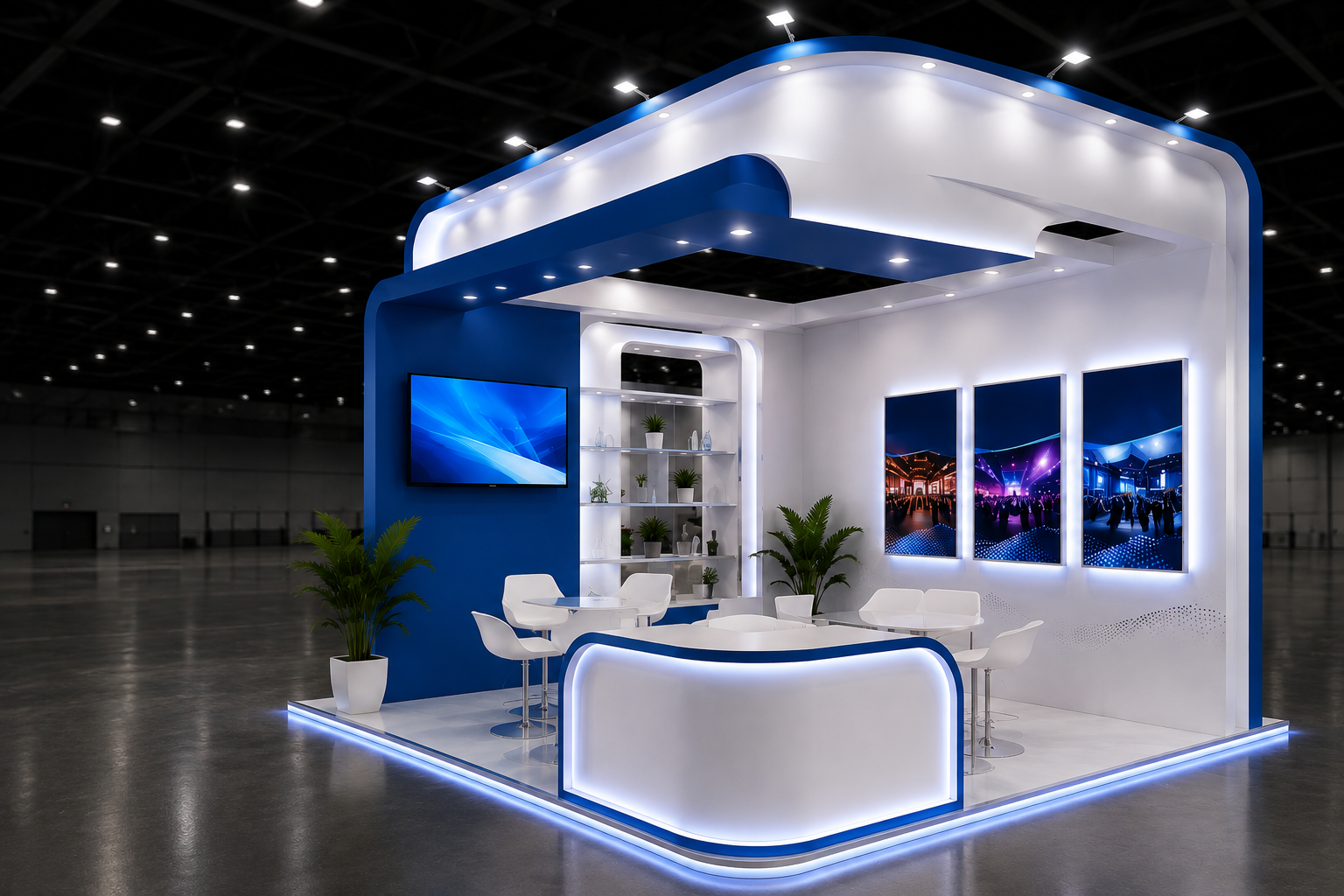
Walk any exhibition hall and you’ll notice the same pattern: some stands pull people in effortlessly, while others — just as expensive, just as well-built — get walked straight past. The difference is rarely the budget. It’s design psychology, layout logic, and a handful of details most exhibitors never think to ask their booth builder about.
Visitors typically decide within seconds whether a booth is worth exploring, and the average attendee visits more than 25 exhibits during a typical show — meaning most stands get only a brief, almost instinctive glance before a visitor commits to stopping or moving on. Industry research also suggests around 85% of attendees base their buy/no-buy decision partly on their experience with a company’s stand, which makes stand design a direct driver of trade show ROI, not just an aesthetic choice.
This guide breaks down the actual booth-builder secrets behind stands that consistently outperform — the psychology of first impressions, the layout principles that invite people in rather than push them away, and the practical design choices that separate a stand people remember from one they don’t.
Key Concepts and Definitions
Booth design psychology — the study of how visual layout, lighting, spacing, and messaging influence a visitor’s split-second decision to approach or ignore an exhibition stand.
Hit rate — in exhibition research, the ratio of visitors who stop at a stand compared to total visitors who pass it, used to measure how effectively a stand captures attention.
Dwell time — the amount of time a visitor spends engaged with a stand once they’ve stopped, a key indicator of how well the layout and content sustain interest beyond the initial approach.
Open entrance design — a layout principle where a stand’s entry points are visually unobstructed and easy to identify, reducing the psychological barrier visitors feel before stepping onto the stand.
Sightline — the unobstructed visual path from the aisle to a stand’s key focal point (product, screen, or branding), which determines what a visitor notices first from a distance.
The Science Behind First Impressions
Cognitive psychology research indicates people form snap judgments in a fraction of a second — some studies from Princeton place initial judgment formation at around 100 milliseconds, well before conscious evaluation kicks in. In an exhibition hall, that means your stand is being judged from the aisle, often before a visitor is even directly in front of it.
This has real design implications:
- The brightest or most visually distinct element gets noticed first. If your key message or product isn’t the visual focal point, visitors’ eyes go somewhere else.
- Visual clutter costs attention. When graphics, products, and messaging all compete for focus, the brain defaults to disengagement rather than effort — visitors are more likely to keep walking than to parse a busy stand.
- Unique design meaningfully outperforms generic design. Research suggests booths with distinctive design capture attention from roughly 70% of attendees, compared to conventional layouts that blend into the row.
Layout Principles That Invite People In
1. Design an Obvious, Open Entrance
Visitors avoid spaces that feel restricted, walled-in, or unclear to enter. If someone has to figure out how to get onto your stand, most won’t bother. Booth builders who specialize in high-traffic conversion consistently prioritize wide, visually open entry points over enclosed or single-file access.
2. Support Natural Movement, Not Forced Paths
A high-performing layout lets visitors move comfortably without feeling funneled, crowded, or redirected against their intent. Forcing a rigid path through the stand can backfire — when movement feels effortless, engagement tends to increase; when it feels controlled, visitors often disengage early.
3. Separate Casual Browsers From Serious Buyers
Not every visitor arrives with the same intent. Some are exploring casually, others are actively evaluating a solution, and a smaller group is ready for a detailed commercial conversation. Strong stand layouts create distinct zones — a browsing area, a demo or interactive area, and a private meeting or negotiation space — so these different conversations don’t compete with or interrupt each other.
4. Put Your Strongest Visual on the Sightline
Whatever you want a visitor to notice first from the aisle — your product, a screen, your core message — needs to sit directly on the sightline, not tucked toward the back. Hiding interactive features or demonstrations at the rear of the stand significantly limits their visibility and effectiveness.
5. Use Lighting Strategically, Not Decoratively
Lighting is one of the most underused tools in booth design. Spotlighting on key products, backlit graphics, and ambient lighting all direct visitor attention toward what matters most — and because visitors tend to notice the brightest object in their field of view first, lighting placement is effectively a tool for controlling first impressions.
Booth Builders’ Secrets: What Experienced Designers Actually Prioritize
| Design Element | What Experienced Builders Do | Common Mistake |
|---|---|---|
| Entrance | Wide, open, visually unobstructed | Narrow or single entry point that feels restrictive |
| Focal point | One clear product/message on the sightline | Multiple competing messages at equal visual weight |
| Graphics | High-resolution, professionally produced | Low-resolution or stretched images that read as unpolished |
| Lighting | Strategic spotlighting on key items | Flat, uniform lighting with no visual hierarchy |
| Layout zones | Distinct browsing, demo, and meeting areas | One undivided space forcing all interactions together |
| Staffing | Trained, approachable staff at the entry zone | Staff clustered at the back or absent from the entrance |
| Interactive elements | Positioned near the aisle for visibility | Interactive tech hidden at the back of the stand |
| Messaging | One clear value statement, minimal text | Dense text walls competing for attention |
Pre-Event Factors That Determine Whether People Even Notice You
Design isn’t the only lever. Visitor behavior data shows that a large share of engagement is decided before the show even opens:
- Roughly 76% of attendees arrive with a pre-planned list of booths they intend to visit — meaning pre-show marketing and positioning matter as much as on-site design for capturing planned visits.
- Giveaways still influence behavior — around 52% of attendees say giveaways affect whether they visit a stand, though relevance matters more than novelty; brand-relevant items tend to outperform generic freebies.
- Staff energy is a measurable differentiator. Well-trained, proactive staff who initiate conversations at the entry zone consistently outperform passive staff waiting for visitors to approach — visitors respond to energy as much as aesthetics.
Benefits of Getting Booth Design Right
- Higher hit rate — more of the visitors walking past actually stop.
- Longer dwell time — visitors who stop stay engaged longer, increasing the chance of a meaningful conversation.
- Stronger lead quality — clear zoning lets your team separate casual browsers from serious prospects without losing either.
- Better brand perception — professional graphics and lighting signal credibility, particularly against international competitors at major shows.
- Improved ROI on the same budget — design psychology principles cost nothing extra to apply; they’re about how a stand is arranged, not how much is spent on it.
Challenges and Considerations
- Budget pressure toward “more stuff.” Exhibitors often default to adding more graphics, screens, and messaging when engagement is low — when the actual fix is usually reducing visual clutter, not adding to it.
- Venue and space constraints. Smaller stand footprints limit how much zoning and open-entrance design is achievable; this is where an experienced builder’s spatial planning expertise matters most.
- Balancing openness with brand privacy. Fully open layouts maximize foot traffic but can make confidential product or pricing conversations awkward — a defined meeting zone solves this without closing off the whole stand.
- Staff coordination. Even a perfectly designed stand underperforms if staff aren’t positioned at the entry zone or aren’t trained to initiate contact quickly.
Best Practices Checklist for a High-Converting Stand
- Confirm your key visual focal point is directly on the aisle sightline.
- Keep entrance points wide and visually unobstructed — avoid walls or high counters near entry.
- Limit primary messaging to one clear statement, not multiple competing claims.
- Use spotlighting on your single most important product or feature.
- Create at least two distinct zones: open browsing and private conversation.
- Position interactive elements (screens, demos) near the aisle, not the back wall.
- Brief staff to actively greet visitors at the entrance rather than waiting at the back.
- Choose giveaways relevant to your brand rather than generic promotional items.
- Start pre-show marketing early — a meaningful share of visitors decide who to visit before arriving.
For a deeper breakdown of specific design tactics — lighting setups, graphics standards, and layout templates — see our detailed guide on exhibition stand design tips to increase visitor engagement.
Industry Trends and Future Outlook
- Interactive and tech-driven engagement is growing. Touchscreens, augmented reality, and live demonstrations are increasingly standard at competitive shows, particularly technology-focused events.
- Psychology-informed design is becoming a differentiator. As more exhibitors invest in premium builds, the stands that stand out are shifting from “biggest budget” to “smartest layout” — open entrances, clear sightlines, and zoned spaces.
- Sustainability is influencing material choices without compromising visual impact, as more builders offer reusable modular systems that still support strong lighting and graphics design.
- Data-driven measurement is entering booth design. Some builders now track hit rate and dwell time using traffic-monitoring tools, allowing design decisions to be tested and refined across events rather than based on intuition alone.
If you’re evaluating who should bring this kind of design thinking to life, our roundup of top exhibition stand builders in Dubai is a good starting point, and our guide on how to select an exhibition booth contractor covers the evaluation process in full.
Frequently Asked Questions
Q1. What makes visitors stop at an exhibition stand?
Visitors stop at stands with a clear visual focal point, an open and unobstructed entrance, and minimal competing messaging. Since first impressions form in a fraction of a second, the single most important element for capturing attention needs to be immediately visible from the aisle.
Q2. How long does it take for a visitor to decide whether to visit a booth?
Research suggests initial judgments form almost instantly — within a fraction of a second — well before a visitor consciously evaluates the stand. This makes the first visual impression from the aisle critical.
Q3. Does booth size determine how many visitors it attracts?
Not directly. Layout, sightlines, and design clarity often matter more than size. Smaller stands with an open entrance and a single clear focal point frequently outperform larger stands with cluttered or unclear messaging.
Q4. How much does staff behavior affect booth engagement?
Significantly. Well-trained staff positioned at the entrance and proactively greeting visitors consistently outperform passive staff — visitor engagement responds to energy and approachability, not design alone.
Q5. What’s the biggest layout mistake exhibitors make?
Overcrowding the stand with too many messages, products, or promotional elements at once. This creates visual competition that causes visitors to disengage and move on rather than stop and explore.
Q6. Do giveaways actually increase booth traffic?
Yes, to a degree — research indicates roughly half of attendees say giveaways influence their decision to visit a stand. However, relevance to the brand matters more than the giveaway’s novelty or cost.
Q7. Should interactive technology be placed at the front or back of a stand?
Near the front, on the sightline from the aisle. Interactive elements like touchscreens or demos positioned at the back of a stand are far less visible and see significantly lower engagement.
Q8. How much does pre-show marketing affect booth performance?
Substantially — a large share of attendees arrive with a pre-planned list of booths to visit, meaning pre-event visibility and positioning directly affect how much of your total foot traffic is already primed to stop.
Conclusion
The stands that visitors can’t walk past aren’t necessarily the biggest or most expensive — they’re the ones designed around how people actually behave in an exhibition hall. Open entrances, clear sightlines, zoned spaces, and strategic lighting all work with visitor psychology instead of against it. Combined with proactive staffing and relevant pre-show marketing, these principles turn passing foot traffic into real engagement — and real engagement into leads.
If you’re planning your next stand and want this kind of design thinking applied to your build, get in touch with our team to discuss your requirements, or explore our exhibition stand planning guide for a full project timeline.
Key Takeaways
- Visitors form first impressions almost instantly — your strongest visual element must sit directly on the sightline from the aisle.
- Open, unobstructed entrances significantly increase the likelihood a visitor will step onto your stand.
- Zoning your stand into browsing, demo, and private meeting areas prevents different visitor types from crowding each other out.
- Lighting and message simplicity are two of the highest-impact, lowest-cost design levers available.
- Staff positioning and energy at the entrance measurably affect engagement, independent of the physical design.
- Roughly 76% of attendees plan their booth visits in advance — pre-show marketing directly shapes on-site traffic.
Tell us about your Requirement
Exhibition Stand Builder in Riyadh, Saudi Arabia: The Complete 2026 Guide
22/08/2026
Riyadh has become the beating heart of trade shows, B2B exhibitions, and corporate events in the Middle East. From the Riyadh International Convention & Exhibition Center (RICEC) to Malham International Exhibition & Convention Center, brands from every industry now compete for attention on the show floor. Choosing the right exhibition stand builder in Riyadh is no longer a “nice to
Read More
